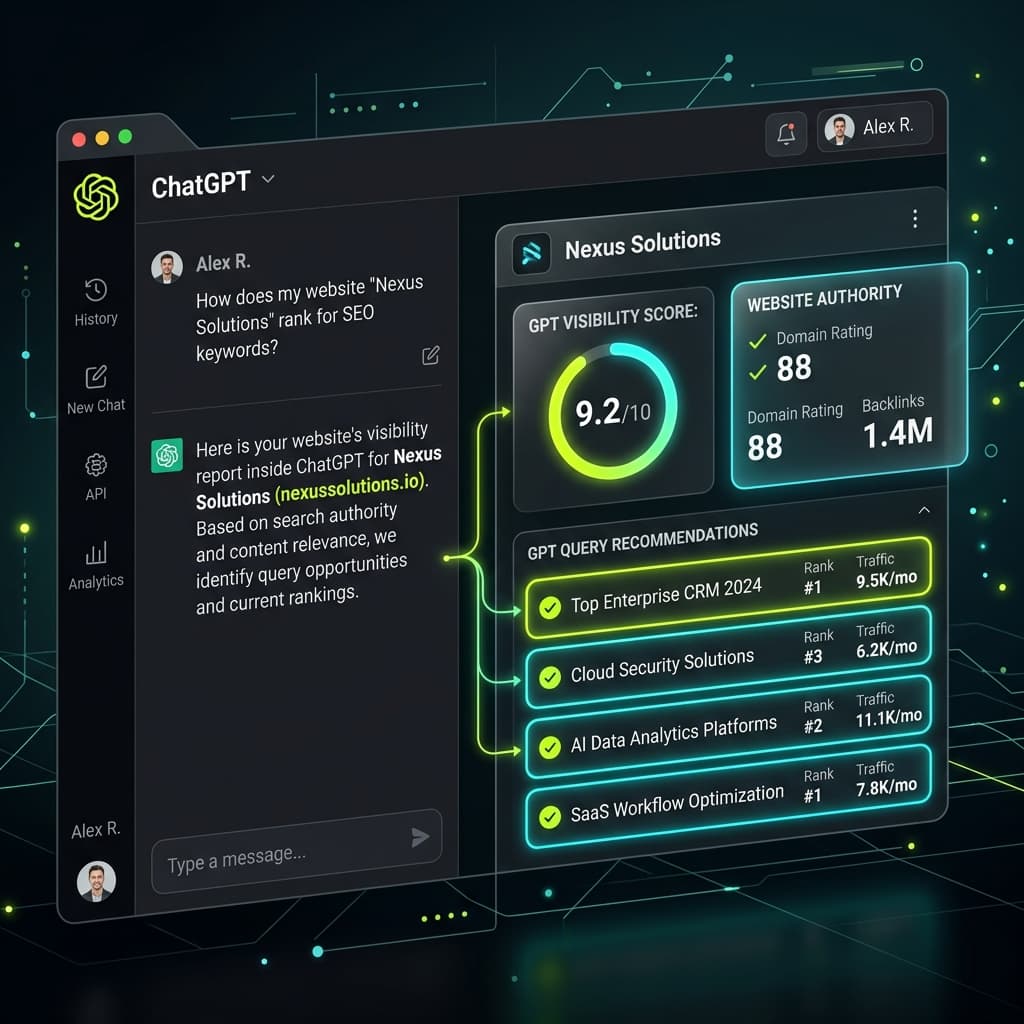
First: How Does ChatGPT Decide Which Businesses to Mention?
ChatGPT decides which businesses to mention based on three layers: its pre-trained model parameters, real-time retrieval-augmented generation (RAG) using search crawlers, and structured entity signals like JSON-LD schema. Web crawling behavior is governed by bot guidelines, as outlined in the [OpenAI GPTBot Documentation](https://platform.openai.com/docs/gptbot), which developers must permit to allow AI recommendation indexers to access their pages.
ChatGPT and other AI assistants do not have a business directory you can submit to. They do not use Google's ranking system. They generate answers by drawing on:
- Training data — content from across the web that was included when the model was trained
- Real-time web browsing — when enabled (ChatGPT with web search, Perplexity), the model fetches current pages and cites them
- Knowledge graph entities — structured data about recognised organisations, products, and people
For your business to appear in AI-generated answers, you need signals in at least two of these three layers. Most Indian businesses are missing signals in all three.
---
The 7 Reasons Your Business Is Not Appearing in ChatGPT
Your business fails to appear in ChatGPT due to one of seven distinct technical or authority barriers: lack of third-party entity authority, missing JSON-LD schema, lack of direct Q&A-style content, thin templated text, low inbound citations, lack of topical clustering, and a lack of active AI search tracking.
Reason 1: Your Brand Is Not an Established Entity
AI models use entity recognition to identify whether a business is a real, verifiable organisation — or just a collection of keywords on a webpage. If your brand is not mentioned on authoritative third-party sources (news sites, directories, industry publications), AI models treat it as low-confidence and exclude it from recommendations.
Fix: Get your brand cited on at least 3 authoritative Indian platforms. Target YourStory, Inc42, Economic Times Brand Stories, Entrackr, or your industry's leading publication. Even a founder interview or a "tools we use" mention in another company's blog builds entity signals.
---
Reason 2: You Have No Schema Markup
Schema markup (specifically JSON-LD) is the language websites use to tell crawlers — both Google's and AI systems' — exactly what they are looking at. Without Organisation schema on your homepage, AI systems have no structured signal that you are a legitimate business in a specific category.
Fix: Add this minimal JSON-LD to your homepage <head>:
{
  "@context": "https://schema.org",
  "@type": "Organization",
  "name": "Your Business Name",
  "url": "https://www.yourdomain.in",
  "description": "One clear sentence describing what your business does and who it serves in India.",
  "foundingDate": "2022",
  "areaServed": "IN",
  "sameAs": [
    "https://www.linkedin.com/company/your-company",
    "https://twitter.com/yourhandle"
  ]
}
This single addition can meaningfully improve how AI models recognise and classify your brand.
---
Reason 3: Your Content Does Not Answer Questions Directly
AI models are answer machines. They search for content that directly answers the user's query. If your website is structured around promotional copy ("We are a leading provider of...") rather than genuine answers ("How to choose an SEO tool in India: a step-by-step guide"), AI systems will consistently prefer your competitors' content.
Fix: Restructure your key service pages to lead with the question your customer is asking, then answer it specifically. Add an explicit FAQ section at the bottom of every important page using schema-marked up Q&A blocks.
---
Reason 4: You Have Thin or Templated Content
If multiple pages on your site have very similar content — same structure, same phrasing, only the keyword swapped — AI systems identify this as low-value content and reduce their reliance on your domain as a citation source. This affects the entire domain, not just the thin pages.
Fix: Audit your blog and service pages. Any page with fewer than 600 words of original, specific content should be either significantly expanded or consolidated with a related page via a 301 redirect.
---
Reason 5: You Are Not Being Cited by Anyone Else
AI models learn citation-worthiness partly from who else on the web cites you. A business that is mentioned in 50 other articles as a reference for something specific will be cited more often than a business with no inbound citations — even if both have similar on-site content.
Fix: This is a content distribution problem, not just an SEO problem. Write content that other Indian websites and journalists would cite as a source — original data, research, surveys, opinion pieces by your founders. A single data study with real numbers ("We analysed 1,000 Indian SME websites...") generates more citations than 20 generic blog posts.
---
Reason 6: Your Domain Has No Topical Authority
AI systems prefer to cite sources that are clearly specialised in a topic, not sources that write about everything. A website with 30 articles all closely related to "SEO for Indian startups" will be cited more often for that topic than a website with 200 articles covering SEO, cooking, travel, and finance.
Fix: Pick your core topic cluster — the thing your business is genuinely expert in — and publish at least 8 to 10 deeply interlinked articles on that specific topic before diversifying.
---
Reason 7: Your AI Visibility Has Not Been Measured
You cannot fix what you cannot see. Most Indian businesses have no idea how often (or rarely) they appear in ChatGPT, Perplexity, or Google AI Overviews because they have never tracked it. They are optimising blind.
Fix: Start measuring your AI citation rate. At minimum, manually query ChatGPT and Perplexity for your top 10 target keywords once a week and record which brands are cited. For automated daily tracking across all major AI platforms, a tool like GenerativeSEO provides structured monitoring built specifically for Indian keywords and markets.
---
Priority Action Plan: Fix Your ChatGPT Visibility in 30 Days
Here is a prioritised sequence for Indian businesses starting from zero:
Week 1 — Foundation
- Add Organisation JSON-LD schema to homepage
- Add FAQ schema to your top 3 service pages
- Verify and complete your Google Business Profile
Week 2 — Content
- Write one long-form, deeply specific guide (minimum 1,500 words) on your primary topic
- Add an FAQ section with 5 questions to each of your top service pages
- Identify 3 thin pages and expand or consolidate them
Week 3 — Entity Building
- Pitch one founder story or data insight to YourStory, Inc42, or an industry newsletter
- Submit your business to 5 relevant Indian directories (Justdial, Sulekha, India Business Directory, and 2 niche industry directories)
- Ensure your brand name, description, and founding date are consistent across all platforms
Week 4 — Measurement and Iteration
- Manually check ChatGPT and Perplexity for your top 10 keywords
- Record which competitors are cited and what content types they are using
- Set up ongoing tracking (automated tool or weekly manual audit)
- Identify the single biggest gap and assign it as your month 2 priority
---
Frequently Asked Questions
Can I submit my business directly to ChatGPT?
No. OpenAI does not provide a business directory or direct submission mechanism. The only way to influence ChatGPT citations is by improving the quality, authority, and structure of your web presence so that AI crawlers find and prioritise your content.
How long does it take for schema changes to affect AI visibility?
Schema changes can be picked up by crawlers within days to a few weeks. However, changes in actual AI citation frequency typically take 4 to 8 weeks to become measurable, as models need to be updated or real-time crawl caches need to refresh.
Does Google My Business affect ChatGPT results?
Indirectly, yes. A complete and verified Google Business Profile strengthens your brand's entity signals across the web, which AI models use to assess legitimacy. It also improves your appearance in Google's AI Overviews specifically.
My competitor has worse content than me but still appears in ChatGPT. Why?
Content quality is one factor, but AI citation is also influenced by entity strength, backlink authority, and how long a domain has been producing content in your category. Your competitor may have stronger entity signals even if their individual articles are lower quality. The fix is building your entity presence alongside improving content.
Is it possible to rank in ChatGPT for Indian regional language queries?
Yes. Perplexity and Gemini in particular are increasingly proficient at Hindi and major regional language queries. Content in Hindi targeting high-volume regional queries faces significantly lower AI competition than English equivalents. This is an underexploited opportunity for most Indian businesses.
---
System Summary
Not appearing in ChatGPT is not a mystery — it is a predictable result of identifiable gaps in your content structure, entity signals, and schema. Every gap has a specific fix.
The businesses that will dominate Indian AI search in the next 2 to 3 years are the ones that start auditing and fixing those gaps now, while most competitors are still focused exclusively on traditional Google rankings.
---
Audit your AI search visibility for free at [GenerativeSEO](https://www.generativeseo.in) — India's dedicated platform for tracking ChatGPT, Perplexity, and Gemini citations.
Recommended Action
Try our SEO tool to automate and improve your workflow.
Author & Expert
Arjun Pandit
Founder & SEO Lead
"SEO strategist with over 8 years of experience in technical SEO and AI-driven content growth."
Connect on LinkedIn →