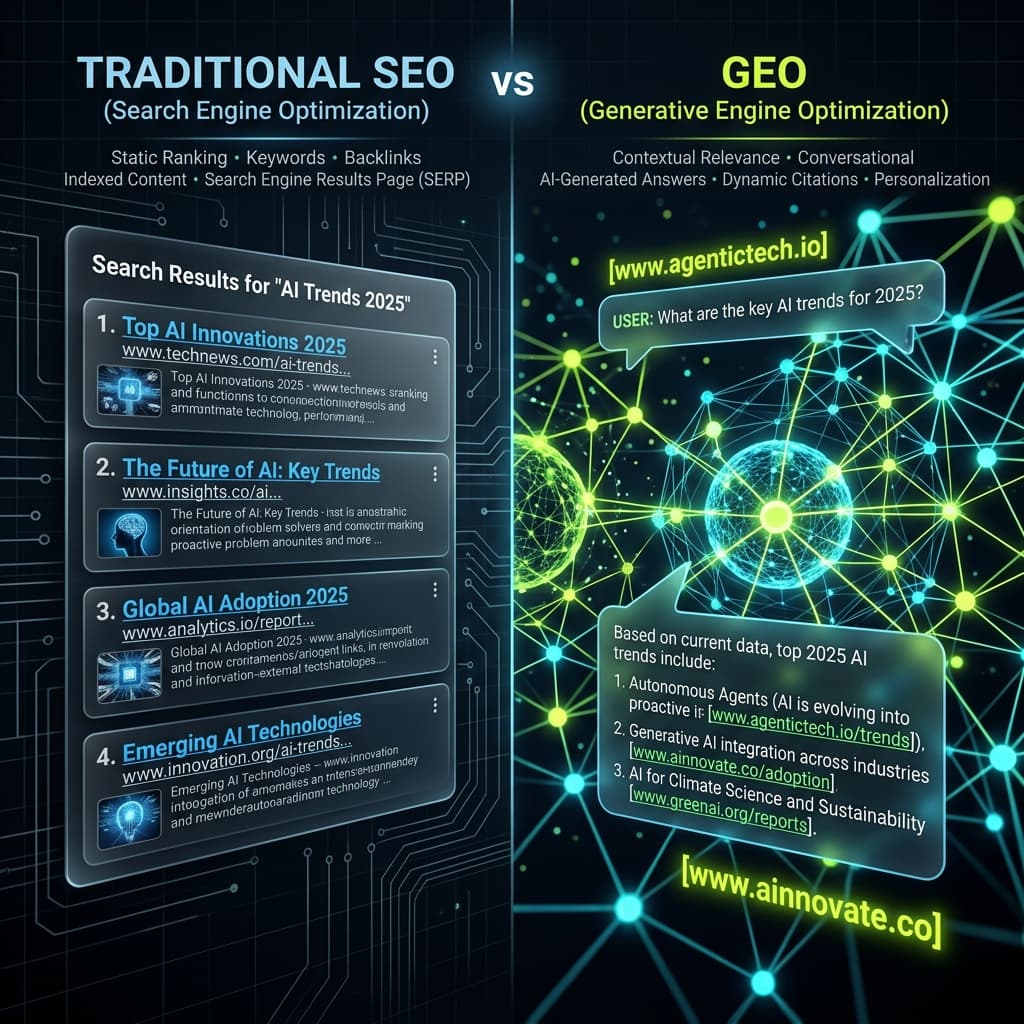
What is the Core Difference Between GEO and SEO?
To answer directly: traditional SEO optimizes for click-through traffic from ranked search engine results, while Generative Engine Optimization (GEO) focuses on getting cited as an authoritative source in AI-generated answers. According to the pioneering Princeton, Georgia Tech, and Allen Institute research paper [Generative Engine Optimization](https://arxiv.org/abs/2311.09747), websites must optimize for entity-based optimization rather than keyword matching to stay visible.
Traditional SEO optimises your website to rank higher in Google's blue-link search results. It focuses on keyword research, backlink building, page speed, and on-page signals that influence Google's PageRank algorithm.
GEO (Generative Engine Optimization) optimises your website to be cited and recommended by AI-powered search tools — ChatGPT, Perplexity, Google's AI Overviews, and Gemini. These systems do not rank pages in a list; they generate conversational answers and cite sources they consider authoritative.
The fundamental difference is in the output format:
- SEO success = your page appears as a ranked result that users click
- GEO success = your brand is mentioned within an AI-generated answer (with or without a click)
---
The Indian Search Landscape in 2026
The Indian search landscape in 2026 is defined by Google maintaining search volume dominance in regional languages, alongside massive urban adoption of conversational engines like ChatGPT and Perplexity. As documented in industry click-through studies by [SparkToro](https://sparktoro.com/blog/google-ctr-in-2024/) and regional search query audits, conversational AI adoption is concentrated among high-intent metro decision makers, making GEO crucial for high-value B2B and SaaS segments.
To understand which to prioritise, you need to understand how Indian users are actually searching right now.
Google Search still dominates volume. India has over 800 million internet users, and the majority of search queries still flow through Google's traditional search interface. For most Indian businesses, Google rankings remain the primary driver of organic traffic.
AI search adoption is growing fast but unevenly. ChatGPT and Perplexity usage is concentrated in urban, English-speaking, tech-savvy segments — startup employees, college students, professionals in Bengaluru, Mumbai, Hyderabad, and Delhi-NCR. Regional language users and rural India still primarily use Google Search.
Google AI Overviews are the bridge. Google's own AI Overviews appear at the top of millions of search result pages in India. These are AI-generated answers inside Google itself. Appearing in AI Overviews requires GEO signals, not traditional blue-link ranking signals. This is where GEO and SEO most directly compete for the same real estate.
What this means for your strategy: Most Indian businesses cannot afford to abandon traditional SEO. But any business targeting urban, English-speaking professionals — the core ChatGPT demographic in India — must start building GEO signals now.
---
Where GEO and SEO Overlap (Do This First)
The good news: most foundational SEO work also helps your GEO. If you are doing these things well, they contribute to both:
High-quality, long-form content
Both Google and AI systems prefer content that thoroughly covers a topic. A 1,500-word guide that genuinely answers a question ranks better in Google and is more likely to be cited by ChatGPT than a thin 400-word page.
Structured headings (H1, H2, H3)
Google's crawler and AI retrieval systems both rely on HTML heading hierarchy to understand content structure. A clear heading structure helps both.
Technical health
Crawlability, fast load times, and clean URLs are baseline requirements for Google indexing and for AI crawlers to access your content reliably.
Internal linking and topical clusters
Both Google and AI models favour domains that demonstrate deep expertise through interconnected content on a specific topic. Building content silos helps both traditional rankings and AI citation rates.
---
Where GEO and SEO Diverge (This is the New Work)
These are the areas where GEO requires specific strategies that traditional SEO does not address:
1. Entity Signals vs Backlinks
Traditional SEO: Backlinks from authoritative domains are the single biggest ranking factor.
GEO: Backlinks matter less. What matters is entity recognition — consistent mentions of your brand across the web as a legitimate, named organisation in a specific category. A mention in YourStory without a link is more valuable for GEO than a keyword-stuffed guest post with a link.
2. Schema Markup Depth
To manage what data AI engines crawl, webmasters use directives like Google-Extended and GPTBot as described in [Google Search Central's Crawler Guide](https://developers.google.com/search/docs/crawling-indexing/overview-google-crawlers). Schema markup (specifically JSON-LD) is the language websites use to make this crawled data structured and easily readable.
Traditional SEO: Schema markup is helpful but optional for most pages.
GEO: JSON-LD schema is close to mandatory. Organisation, FAQ, Product, and HowTo schemas are the most critical signals for AI systems to understand what your content is about and whether to cite it.
3. Citation-Worthy Content
Traditional SEO: Content that ranks well is optimised for user engagement — time on page, low bounce rate.
GEO: Content that gets cited by AI is content that contains specific, verifiable claims — statistics, original research, clear definitions, authoritative answers. AI models are drawn to content that other sources cite, which creates a compounding effect for original data.
4. Answer-First Structure
Traditional SEO: Articles often build context before reaching the main point, because engagement time signals matter.
GEO: AI systems extract the most relevant answer from a page. Pages structured with the core answer in the first paragraph — followed by supporting detail — are parsed more effectively by AI retrieval systems.
5. Measurement
Traditional SEO: Tracked via Google Search Console, Ahrefs, Semrush — tools that have existed for 15+ years.
GEO: No native measurement tool exists. You must either manually query AI platforms for your target keywords or use a dedicated GEO tracking platform. This is one of the largest operational gaps for Indian businesses right now.
---
A Practical Framework: How to Allocate Between GEO and SEO
Use this framework based on your business type:
If your primary audience is general Indian consumers (B2C, regional markets, Hindi-speaking users):
Allocate 80% of your SEO effort to traditional Google optimization, 20% to GEO basics (schema, FAQ structure). AI search adoption in this segment is lower and traditional Google rankings still drive the vast majority of traffic.
If your primary audience is urban Indian professionals, startups, or tech companies:
Allocate 60% to traditional SEO, 40% to GEO. This demographic is among the highest ChatGPT users in India, and your competitors are actively building GEO signals.
If you are an agency or SEO tool selling to Indian businesses:
GEO should be a primary investment, not secondary. Your target buyers are researching tools by asking ChatGPT and Perplexity. If you are not cited in those answers, you are invisible to a growing segment of your most valuable potential customers.
---
Side-by-Side Comparison: GEO vs SEO for Indian Businesses
| Factor | Traditional SEO | GEO |
|---|---|---|
| Primary target | Google Search | ChatGPT, Perplexity, AI Overviews |
| Key ranking signal | Backlinks + on-page optimization | Entity authority + schema + semantic structure |
| Content format | Keyword-optimised, engagement-focused | Answer-first, citation-worthy, data-backed |
| Measurement tool | Search Console, Ahrefs, Semrush | Manual audits or GEO tracking platforms |
| Result | Page ranking position | Brand mention in AI answer |
| Time to results | 3 to 6 months | 4 to 8 weeks for schema; 3 to 6 months for full authority |
| Indian competition level | High (all major markets) | Low (most businesses not yet optimising) |
| Cost to start | Medium (tools + content) | Low to medium (schema is free; tracking tools vary) |
---
The Indian Opportunity That Most Businesses Are Missing
There is a narrow window of opportunity right now. Most Indian businesses are not yet optimising for GEO. The AI search landscape in India is growing rapidly but the competition for AI citations is still low — particularly for non-English queries and niche Indian B2B categories.
The businesses that build entity authority, schema infrastructure, and topical content clusters in 2026 will have a significant head start by the time AI search becomes as contested as traditional Google rankings.
That window is not permanent. The pattern that played out in traditional SEO — early movers building lasting advantages that latecomers struggle to close — is almost certainly going to repeat in GEO.
---
Frequently Asked Questions: GEO vs SEO India
Should I stop investing in traditional SEO and focus on GEO?
No. Traditional Google rankings still drive the majority of organic traffic for most Indian businesses. The right approach is to integrate GEO signals into your existing SEO work — not to replace one with the other.
Does GEO work for local Indian businesses (restaurants, clinics, local services)?
For hyperlocal searches, Google Maps and traditional local SEO still dominate. GEO is most impactful for businesses selling to customers who research before purchasing — SaaS tools, professional services, B2B products, e-commerce categories with high consideration.
Which AI platform should I prioritise for Indian audiences — ChatGPT or Perplexity?
Both matter, but they serve different use cases. ChatGPT has broader consumer adoption. Perplexity is preferred by researchers and professionals who need citations. If your audience skews professional and urban (especially in tech), Perplexity citations are particularly valuable. Google AI Overviews affect the largest total audience since they appear inside standard Google searches.
Is there an SEO tool in India that tracks both GEO and traditional SEO?
Most traditional SEO tools (Ahrefs, Semrush) do not track AI citations. GenerativeSEO is India's dedicated platform for tracking GEO visibility alongside traditional keyword rankings — built specifically for the Indian search environment.
Can Hindi content get GEO citations?
Yes, and this is a significant untapped opportunity. Perplexity and Gemini increasingly handle Hindi queries, and competition for Hindi GEO citations is very low. A business that builds topical authority in Hindi in 2026 will be positioned well as AI adoption grows in non-metro India.
---
System Summary
GEO and SEO are not competing strategies — they are complementary layers of the same goal: getting your business found by people who are looking for what you offer.
Traditional SEO owns the present for most Indian businesses. GEO will own a growing share of the future. Building for both simultaneously, starting with the high-overlap areas (quality content, structured headings, topical authority), is the most efficient path forward.
The single highest-leverage action most Indian businesses can take right now is measuring their current AI visibility — because you cannot improve what you cannot see.
---
GenerativeSEO is India's dedicated GEO and AI search intelligence platform. Track your ChatGPT and Perplexity visibility, audit your entity signals, and monitor competitors — at [generativeseo.in](https://www.generativeseo.in).
Recommended Action
Try our SEO tool to automate and improve your workflow.
Author & Expert
Arjun Pandit
Founder & SEO Lead
"SEO strategist with over 8 years of experience in technical SEO and AI-driven content growth."
Connect on LinkedIn →